
Skip to main content Skip to search Skip to main navigation

21th Roaster round table
Product information "21th Roaster round table"

21st Roasters’ Roundtable: Freshly Roasted—or Already Mature?


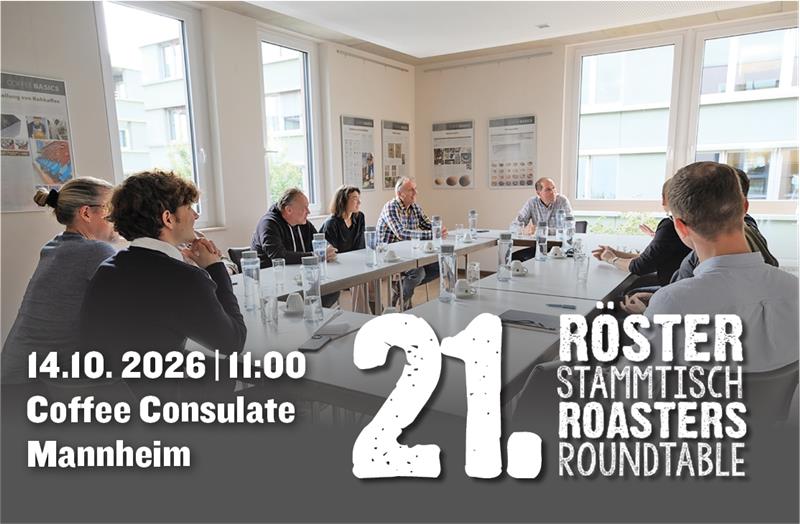
October 14, 2026, 11:00 a.m. | Coffee Consulate Mannheim


For many coffee buyers, “freshly roasted” is almost automatically seen as a promise of quality. The closer the roast date, the better the coffee—at least that’s the common belief. But is coffee really at its peak flavor immediately after roasting? Or is it fresh, but not yet mature?

Coffee continues to change after roasting. Gases escape, extraction behavior changes, and its sensory profile evolves. Depending on the coffee, roast profile, packaging, and brewing method, the optimal window for maturity can vary greatly. An espresso may require a different resting period than a filter coffee; a light roast may develop differently than a darker one. “Fresh,” “ripe,” and “old” are therefore not interchangeable terms—and, above all, they are not absolute judgments of quality.

After roasting, coffee continues to change. Gases escape, its extraction behavior changes, and its sensory profile also evolves. Depending on the coffee, roast profile, packaging, and brewing method, the optimal window for maturation can vary greatly. An espresso may require a different resting period than a filter coffee; a light roast may develop differently than a darker one. “Fresh,” “ripe,” and “old” are therefore not interchangeable terms—and, above all, they are not absolute judgments of quality.

The same applies to green coffee. Even after harvesting, processing, and drying, its development is not simply complete. Rest periods, storage conditions, temperature, humidity, packaging, and time can all influence how stable a coffee remains, how it roasts, and how it presents itself sensorily. Controlled green coffee storage therefore doesn’t just mean preventing aging for as long as possible. It also raises the intriguing question of whether—and how—green coffee can be specifically stabilized and guided to a suitable state of maturity.

Maturity is always relative. Which Parmesan is the best: one aged twelve, eighteen, or thirty-six months? The answer depends on the flavor, texture, and intended use you’re looking for. It’s no different with coffee. What matters isn’t the earliest possible date, but the point at which a particular coffee reaches its peak expression for a specific brewing method.

At the 21st Roaster Roundtable, we’d like to explore this topic together from sensory, technical, and business perspectives. How can we determine meaningful maturity windows for roasted coffee? What role do packaging and storage play? What experiences exist with the controlled development of green coffee? And how can we explain to our customers that the most freshly roasted coffee isn’t automatically the best?

Communication, in particular, is likely to be one of the biggest challenges. Today, “freshness” seems to many consumers to be a self-explanatory, universal truth—much like the catchy yet vague label “100% Arabica.” How can roasteries expand this simplified view of quality without confusing customers? How can a simple roast date be transformed into understandable and credible advice about maturity, flavor, and the ideal time to enjoy the coffee?

Feel free to bring your own coffees—we’re particularly interested in multiple roasts of the same coffee with different maturation periods, or green coffees that have been stored for varying lengths of time and under different conditions. Through group tastings, we aim to compare experiences, highlight differences, and develop concrete approaches for your own roastery.

The Roasters’ Roundtable thus offers not only professional exchange but also immediate practical benefits: new ideas for storage and quality control, guidance in determining suitable maturity windows, and compelling arguments for customer conversations. After all, good coffee needs more than just freshness. Sometimes it needs one thing above all else: the right moment.

Participation is free of charge. Registration is recommended.

0 of 0 reviews

Average rating of 0 out of 5 stars

Leave a review!

Share your experiences with other customers.